
Physical inactivity was declared a pandemic in 2012.
“Physical inactivity is the fourth leading cause of death worldwide.” [i]
Read that again and let it sink in.
Long before “The Pandemic,” the one that everyone thinks about when you mention it, there was another pandemic growing in severity. It’s The Physical Inactivity and Sedentary Behavior Pandemic and it continues to escalate, bringing loss and devastation in its wake.
Think of the news coverage, the media, and the extreme precautions taken during the pandemic:
Masks.
Social distancing.
Lockdown mandates.
Heated debates on various sides of the issue.
It’s a very unique time in our current history to say the least!
Now think of this Physical Inactivity Pandemic … that you likely haven’t heard of…
No sounding the alarms.
No hyped up media coverage.
No awareness, precaution or extreme measures taken.
…Radio silence?
In fact, the Physical Inactivity Pandemic likely set the perfect stage for the COVID-19 Pandemic to be even more severe, as our collective health status was compromised and it continues to decline. These cascading circumstances created the perfect storm.
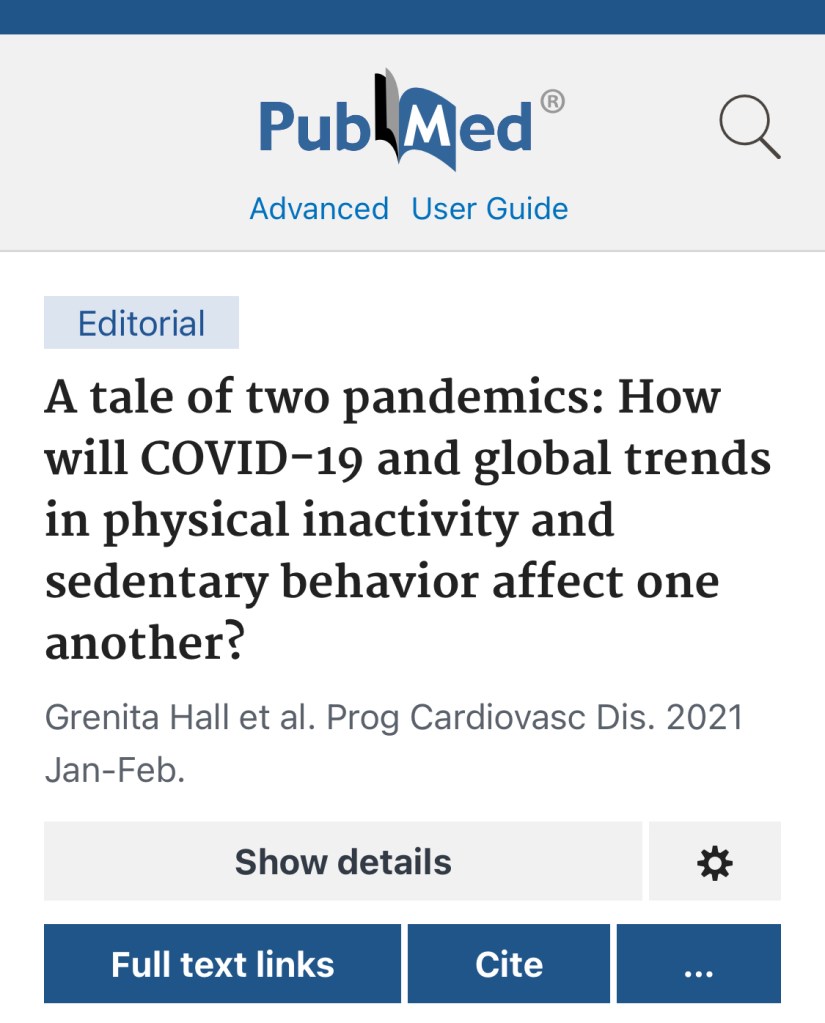
The Sedentarism Pandemic made The Pandemic worse. And The COVID Pandemic escalated our trend towards staying inside, moving less, turning to food for pleasure, ordering more take out and becoming even more dependent on technology. [ii] [iii] [iv]
Movement was never meant to be “optional.” Our bodies are made to move and we only get one body.
We’ve got to move. We’ve got to fight. We’ve got to choose change, healthy living and promote awareness.
And change starts with you.
Physical inactivity contributes to the rise we see in lifestyle-related diseases: metabolic syndrome, type II diabetes, heart disease, cancer, obesity and more.
“Although there is robust evidence that physical activity (PA) is integral in preventing and managing chronic diseases, 80% of American adults do not meet the US Physical Activity Guidelines for exercise and 66% of American children are physically inactive every day.” ~Harvard Medical Student Review “Physical Inactivity Crisis & the COVID-19 Pandemic: Time is Now to Implement Exercise as Medicine in Medical School Teaching”
“These findings collectively foretell a concerning future where people continue to move less overall and will experience a poorer health trajectory as a result. Perhaps it would be more appropriate at this time to rename the Pl pandemic to the sedentarism pandemic.” [v]
The Sedentarism Pandemic
So here we are in another unique time in human history.
Plagues, pestilence, poverty and lack were the main threats to mankind in past centuries. Now we die from excess and comfort. The foods we eat, the inactivity we partake in and the modern day comfort of technology: always there to give, to pacify us.
Your health is in your hands.
We’ve never lived in a time in human history where it was easier to destroy yourself with the foods you eat and physical inactivity… And conversely, it’s never been easier to eat healthy, get active and get help.
I’ve personally experienced the loss and devastation from losing family members and the pain that lifestyle-related disease can cause.
It’s one of the reasons I’m so passionate about my own health journey and helping others find meaning in their health journey.
“I helped a man climb a mountain, and found that I too had reached the top.” ~Unknown
Here are my Five Tips for Being Healthy, Staying Active and Eating Well
- Mindset
Assess where you currently are. Be gentle and loving to yourself. Build on where you are. All change starts with awareness and continual change requires continual focus.
Take Extreme Ownership of your health journey and act today!
- Daily Movement, Steps and Walking
Start with walking 5-10 minutes a day or more and build up from there. (If you need some incentive, it is estimated that for every hour of sitting it cost the older adult $126 in health care spending [vi]… care about your health? Go for a walk.) A recent meta-analysis also shows that getting 8,800 steps a day lowers all-cause mortality by 50%. [vii] Again, your body is made to move. Movement is Medicine!
- Strength Training (For Life)
Understand strength training has many unique benefits. It can help you fight metabolic disease, metabolic syndrome and type II diabetes along with building muscle mass and bone mineral density so you can age well. [viii]
Strength training offers quality and quantity of life benefits. [ix] Two days a week to start is perfect. Then aim to build to 3-4 weekly using progressive overload while following an intelligently designed exercise program.
- Healthy Nutrition Habits
If you are after body transformation and truly being healthy then practicing good nutrition is a non-negotiable.
The average U.S. daily intake of food was “3,914 calories per person per day in 2023.” [x] This huge calorie surplus leads to weight gain and metabolic dysfunctions. Pair this with an average of 20 minutes or less of physical activity per day and it’s not hard to see why we have an obesity epidemic, we’re seeing lifestyle-related diseases at an all-time high, and the projected future health of our country continues to decline.
We need a Nutritional Intervention!
I’ve written a whole article series on Good Nutrition.
Good Nutrition: Why It Matters?
Good Nutrition: What Is Good Nutrition?
Good Nutrition: Nutritional Triage
Good Nutrition: The Best Advice You Can Use Right Now!
And here is a practical article I’ve written to help you focus on critical health behaviors:
Less Than 3% of Americans Meet These 4 Basic Health Standards: Are You One of Them?
- Sleep, Stress Management and Recovery
You’ll also need to pay attention to this often-overlooked aspect of the equation.
Positional breathing techniques, true mobility work, good sleep hygiene habits and investing your own recovery can help with energy levels, mood, longevity and much more.
Your Move! (You Got This!)
I hope you can join me in being the minority and together we can change the projected metabolic health of this county.
You matter. Your future matters.
Choose to build a healthy relationship with food, fitness and your future self.
Download my Body Transformation Guide HERE to help you get started and consider sharing this article with a loved one whose health you care about.
If you want to take your body back and get control of your health, Nutritional Mastery Coaching can help you:
- Learn to eat better, without dieting or feeling deprived.
- Get active and moving no matter what shape you’re in.
- Produce lifelong change inside and out for a brighter healthier future.
You can choose health, and I can help navigate and walk with you on your journey.
I’d love to learn more about you, your goals and your story.
Schedule your complementary Success Session to learn more about Nutritional Mastery coaching. I look forward to hearing from you and helping you on your health journey.


DO YOU NEED HELP TRANSFORMING YOUR BODY AND HEALTH?

Helping You Eat, Move, and Live Better Through The Power of Good Nutrition, Meaningful Movement and Healthy Habits So You Can Live A Life Of Transformation Inside and Out.
[i] Kohl, Harold W 3rd et al. “The pandemic of physical inactivity: global action for public health.” Lancet (London, England) vol. 380,9838 (2012): 294-305. doi:10.1016/S0140-6736(12)60898-8
[ii] Chen, P., Mao, L., Nassis, G.P., Harmer, P., Ainsworth, B., & Li, F. (2020). Coronavirus disease (COVID-19): The need to maintain regular physical activity while taking precautions. Journal of Sport and Health Science, 9, 103-104.
[iii] Mattioli, A.V., Puviani, M.B., Nasi, M., & Farinetti, A. (2020). COVID-19 pandemic: The effects of quarantine on cardiovascular risk. European Journal of Clinical Nutrition. doi: https://doi.org/10.1038/s41430-020-0646-z
[iv] Jiménez-Pavón, D., Carbonell-Baeza, A., & Lavie, C.J. (2020). Physical exercise as therapy to fight against the mental and physical consequences of COVID-19 quarantine: Special focus in older people. Progress in Cardiovascular Diseases. doi: https://doi.org/10.1016/j.pcad.2020.03.009
[v] Grenita Hall, Deepika R. Laddu, Shane A. Phillips, Carl J. Lavie, Ross Arena,
A tale of two pandemics: How will COVID-19 and global trends in physical inactivity and sedentary behavior affect one another?,
Progress in Cardiovascular Diseases, Volume 64, 2021, Pages 108-110, ISSN 0033-0620,
https://doi.org/10.1016/j.pcad.2020.04.005.
(https://www.sciencedirect.com/science/article/pii/S0033062020300773)
Keywords: Physical activity; Physical inactivity; Sedentary behavior; Exercise; COVID-19
[vi] 15.Rosenberg D., Cook A., Gell N., Lozano P., Grothaus L., Arterburn D. Relationships between sitting time and health indicators, costs, and utilization in older adults. Prev Med Rep. 2015;2:247–249. doi: 10.1016/j.pmedr.2015.03.011.
[vii] Stens, Niels A et al. “Relationship of Daily Step Counts to All-Cause Mortality and Cardiovascular Events.” Journal of the American College of Cardiology vol. 82,15 (2023): 1483-1494. doi:10.1016/j.jacc.2023.07.029
[viii] Kaminsky, Leonard A et al. “Working Toward Optimal Exercise Prescription: Strength Training Should Not Be Overlooked.” Journal of cardiopulmonary rehabilitation and prevention vol. 42,2 (2022): E32-E33. doi:10.1097/HCR.0000000000000696
[ix] Dubnov-Raz G. [EXERCISE IS MEDICINE, INCLUDING STRENGTH TRAINING!]. Harefuah. 2019 Aug;158(8):506-508. Hebrew. PMID: 31407537.
[x] Source: USDA, Economic Research Service using data from the Food and Agricultural Organization of the United Nations, FAOSTAT Statistical Database (calories) and Euromonitor International (spending).
 nutritionalmastery.com